Why So Many Places Have More Than One Name
Why places have more than one name: learn how official, inherited and everyday names preserve different memories, and choose which one fits the moment.
You ask for directions to the old mill district, but the bus display calls it Riverside, and a neighbour says you mean Mill End. Why places have more than one name is rarely a puzzle with one correct answer. Different names can preserve different chapters of a place’s life, and each may still serve a distinct purpose.
A place name can begin as a practical description, gather associations through use, then acquire an official form—or lose one. The result is less a neat sequence than a stack of names, kept alive by maps, institutions, families and ordinary conversation. To understand them, compare three kinds: the official name, the inherited local name and the newer or parallel name.
What does an official name do?
An official name is the one adopted by an authority for a defined purpose: a municipality may use it in records, a postal service in delivery systems, or a transit agency on signs. The same place can have different official labels in different systems because those organizations divide and identify territory in different ways.
That administrative name is useful when precision matters. It helps people match an address to a service area, locate a district on a map or identify the jurisdiction responsible for a public facility. A formal name can also make a place legible to people who have no personal history there.
But official status does not make a name timeless, neutral or universally loved. Authorities may standardize spelling, combine settlements, rename a district or adopt a name associated with a new political order. A sign can change quickly; the habits and memories attached to the former name may not.
Suppose a town council adopts “Northbank” for a district long called “Ferry Flats.” A new map and municipal form may use Northbank, while a resident still says Ferry Flats to describe the same cluster of streets. The formal name helps with official business; the older one may identify a familiar place and its remembered character.
Why do inherited names stick?
Inherited names often survive because they are woven into repeated speech. A family may refer to “the old quarry road” long after quarrying has stopped. Shopkeepers, schoolchildren and delivery drivers can keep a name in circulation without agreeing on when it began or what its boundaries are.
These names may preserve local details that a clean administrative label leaves out: a former land use, a landscape feature, a meeting place or the name of a nearby settlement. They can also carry affection, resentment or a sense of belonging. Memory does not always come with a plaque; sometimes it travels in a phrase passed from one generation to another.
Inherited names can be imprecise, too. One person may use a familiar name for a few blocks; another may mean the wider area. Boundaries shift with context, and a name that feels obvious to longtime residents may be unfamiliar to a newcomer. That does not make it useless. It means the name works best when speakers understand the shared reference.
There is a difference between preserving a name and assuming that every old name should be used without question. Some labels encode exclusion or reflect a history that affected residents unevenly. Asking who uses a name, who recognizes it and what it recalls can reveal more than simply calling it “traditional.”
When do new or parallel names appear?
A new name may emerge as a neighbourhood changes, a community organizes or people seek recognition for a history that an older label overlooks. A name can also arrive through development, tourism or a new institution. Sometimes a fresh label catches on; sometimes it remains mostly on brochures and property signs.
Parallel names need not compete for a single winner. A district might have a formal name for services, an older name used by nearby residents and a name associated with a particular cultural or language community. Each can point to a different relationship with the same ground.
That coexistence calls for care. A proposed name may restore a suppressed memory, but it may also be unfamiliar to people who rely on a long-used local term. Changing a sign is a public act, not just a typographic choice. Listening for how names are used—and by whom—helps distinguish living usage from a label that has little connection to daily life.
Which name fits the moment?
Choosing a name depends on what you are trying to do. Use the label that helps your listener identify the place, and add another name when it clarifies a mismatch or acknowledges a meaningful local usage.
- For official forms or services: use the name shown by the relevant agency or map, so the place can be matched to its records.
- For conversation with a local: follow the name they use, or ask whether a familiar older label refers to the same area.
- For a place with several recognized names: give both at first mention, then explain the distinction if it matters.
- For a disputed or newly proposed name: identify who uses it and what history it represents rather than presenting one version as universal.
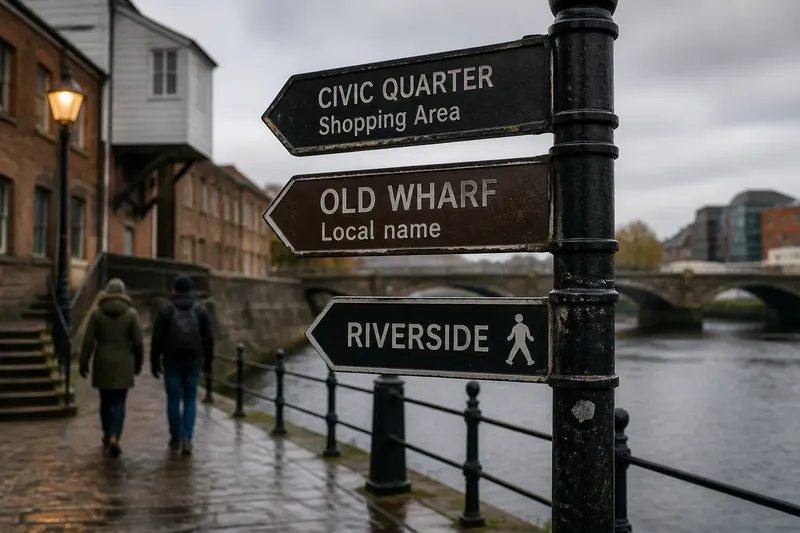
Say you are meeting a friend near a market that maps call “Civic Quarter,” while nearby residents still call it “Old Wharf.” You could say, “Let’s meet at the market in Civic Quarter, the area locals call Old Wharf.” That wording gives your friend a map-friendly reference and preserves the name likely to make sense on the street.
What is not worth the effort is correcting every speaker as if one label could settle a place’s identity. If the meaning is clear, a small explanation is usually more useful than a debate over which name counts as the real one.
What do readers usually ask about place names?
Can one place have two official names?
Yes. Different authorities or services may use different formal labels for the same area, and a place may also have recognized names in more than one language. Check which institution’s naming system matters for the task at hand.
Why does an old name survive after a place is renamed?
People keep using names they learned through family, work and daily routines. A new sign can establish an administrative label without instantly replacing the words people use among themselves.
How can I tell whether a local name is still in use?
Listen to residents in ordinary conversation, look for the name in local organizations’ materials and ask what area the name refers to. A name may be familiar to one community and unknown to another.
Should I use the official name or the local one?
Use the official name where formal records or navigation require it, and the local name where it helps people recognize the place. If the names differ, giving both briefly can be clearer than choosing one without context.
What can a name reveal about a place?
Looking at several names side by side turns naming into a way of noticing whose memory is present. The official label may show how an institution organizes space; an inherited name may preserve an older livelihood or landmark; a newer name may signal a claim to recognition. None tells the whole story alone.
To follow those layers, start with a name you hear in conversation, then compare it with a street sign or municipal map. Ask what each source is trying to identify, and whether the names refer to the same boundaries. That simple comparison can make the place feel more specific: not a blank patch with competing labels, but a shared location carrying several histories at once.