How to Read a Public Square Through Its Edges and Seating
A slow walk through a public square shows how its edges, entrances and seating support different uses, helping you understand who can pause and pass.
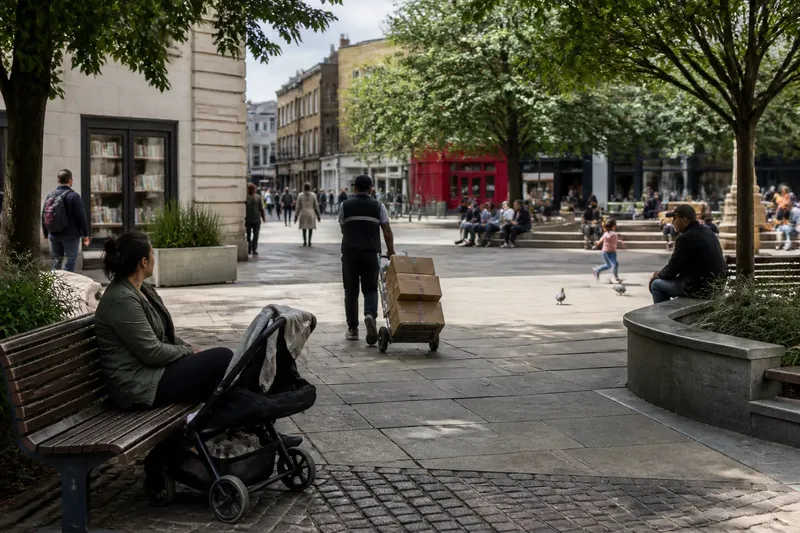
A slow walk through a public square can reveal why one corner fills with conversation while another stays clear. A delivery worker crosses with a handcart; someone leans on a low wall; a child follows the shade of a tree. Watch how the space’s edges and seating shape those choices, and the square begins to feel less like a blank patch on a map.
Start outside, follow a boundary, cross through the space, then pause somewhere you are welcome to sit. This is not a tour of every feature. It is a way to notice how a public square accommodates people who want to linger, meet, play or keep moving.
Where do people enter the square?
Stand just beyond an entrance, away from the main route, and watch how people arrive. A broad opening may look like the natural entrance, while a narrower gap beside a planter might be the route people use to reach a bus stop or storefront. Look for paths that connect the square to nearby streets, transit stops and public buildings.
Notice what happens at the threshold. Some people may turn toward a bench or fountain; others may continue straight across. A low wall, a change in paving or an unclear gap can make one entrance feel less inviting than another. The useful question is not whether every route looks alike, but whether people can tell where they can go.
Keep clear of entrances as you observe. There is little value in counting every passerby or guessing why someone chose a particular route. A few repeated patterns are enough to show whether the square works mainly as a destination, a shortcut or both.
What do the boundaries invite people to do?
Follow one side of the square at an unhurried pace. Its edge might include café tables, a fountain, a noticeboard, tree shade or a plain stretch of paving. These features can make room for different kinds of pause: a quick rest, a conversation or a place to watch the activity in the center.
Look at how the boundary meets the surrounding street. Trees may soften the transition; a curb may separate seats from a route used by bikes or delivery carts. Check whether people can pass along the edge without squeezing between chairs, signs and scooters. The boundary is often where the square’s public life meets the everyday uses around it.
Then look inward. Can you see a clear way across, and are there smaller pockets where someone can sit apart from a group? An open center can help people gather, but a planter or low wall may also make a quieter place without closing off a useful route.
Which seats work for different visits?
Compare the seating by location and outlook, not just by shape. A bench facing the center can suit conversation or people-watching. A seat beneath a tree offers shade; a ledge may allow a brief rest but feel less comfortable for a longer one. A seat beside a busy path gives a visitor a sense of company, while one near planting may feel more sheltered.
Notice whether people can use the seats without asking others to move. Is there room for a wheelchair beside a bench? Can someone with a stroller pause without blocking a route? Are some seats exposed to wind or sun while others have shelter? These practical details help explain why one spot is occupied and another is not.
Imagine you arrive with a tote bag and a stroller while a group gathers near the central bench. You look for a shaded seat near the edge, with space to keep the stroller beside you and the path open. The result is a comfortable pause that does not force anyone else to shift.
How do different activities share the space?
Look for places where activities meet. A child might play near a route used by people crossing the square; a street musician might draw a small audience without stopping everyone else. Watch how people make room: someone steps aside, a group gathers beyond the main path, or a passerby pauses to let a cluster clear.
Different uses need different amounts of space. One person reading can settle near a planter; a group meeting needs room to stand; someone carrying groceries may need a direct route. Notice where these activities coexist and where they compete. The point is not to decide who belongs, but to see which parts of the layout make sharing easier.
Keep the observation respectful. Avoid photographing strangers at close range or treating a private conversation as material for a story. You can understand a square through its paths, seating, sounds and patterns of use without making its visitors feel watched.
What should you look for on a short visit?
How do I choose a place to observe?
Choose a spot beside a wall or planter, where you can see an entrance without standing in its flow. If that view is blocked, move to another quiet edge rather than stopping in the path.
What should I notice about seating?
Compare shade, shelter, outlook and the space beside each seat. If a seat leaves a clear route and a place for a mobility aid or stroller, note that practical advantage; if it narrows the path, observe from another position rather than occupying the pinch point.
Should I visit during an event?
An event can show how the square handles a crowd, but it may obscure its ordinary routines. If the area is busy, watch from a respectful distance; if the crowd blocks access or makes observation intrusive, return at a quieter time.
Is it useful to photograph people?
Close-up photographs can make visitors feel exposed and are not needed to understand how the layout works. If you want a record, note features such as a shaded bench or a narrow entrance instead, and follow local rules about photography.
How can you make the walk concrete?
Say you begin at a square with a wide entrance by a bookstore, a narrow opening beside a planter and two benches, one in full sun and one under a tree. You stand beside the bookstore wall, keeping the entrance clear, and notice that people heading toward the bus stop use the narrow opening. You follow the edge, see that the sunny bench faces the central path while the shaded bench has room beside it for a stroller, then cross through the open center. Your observation is specific: the narrow gap connects a useful route, and the shaded seat makes a more comfortable place to pause without narrowing that route. You have not needed to count anyone or infer their reasons.
- Check whether an entrance is visible from the surrounding street; if it is easy to spot, observe how it connects to nearby routes, but if it is concealed, look for signs or another clear approach.
- Check whether your observation spot leaves the entrance unobstructed; if it does, stay there, but if people must detour around you, move beside a wall or planter.
- Check whether the edge has shade, shelter or a place to lean; if it offers a comfortable pause, note what feature helps, but if it is exposed or crowded, continue to another boundary.
- Check whether a path passes close to benches or café chairs; if people can pass freely, note the clear separation, but if the route narrows, observe from outside the pinch point.
- Check whether a seat has room beside it for a wheelchair or stroller; if the space remains open, note that useful option, but if it is blocked, look for another seat with clearer access.
- Check whether planting divides the square without closing off a route; if both a quiet pocket and a clear crossing remain, note how the layout serves both, but if the route is cut off, observe another way through.
- Check whether a crowd or event is changing the ordinary use of the square; if it is easy to keep a respectful distance, watch from the edge, but if access is blocked or people seem crowded, leave the observation for another visit.
It is not worth turning a quiet walk into a full inventory of paving, furniture and every person who passes. A few clear observations tell you more than a tally. On your next slow walk through a public square, notice one entrance, one boundary and one seat; those details can show how the place makes room for both movement and a pause.