Street Corner Wayfinding That Makes Unfamiliar Routes Easier
Street corner wayfinding turns an unfamiliar walk into clear decisions, helping you choose the right turn and remember how to retrace your route.
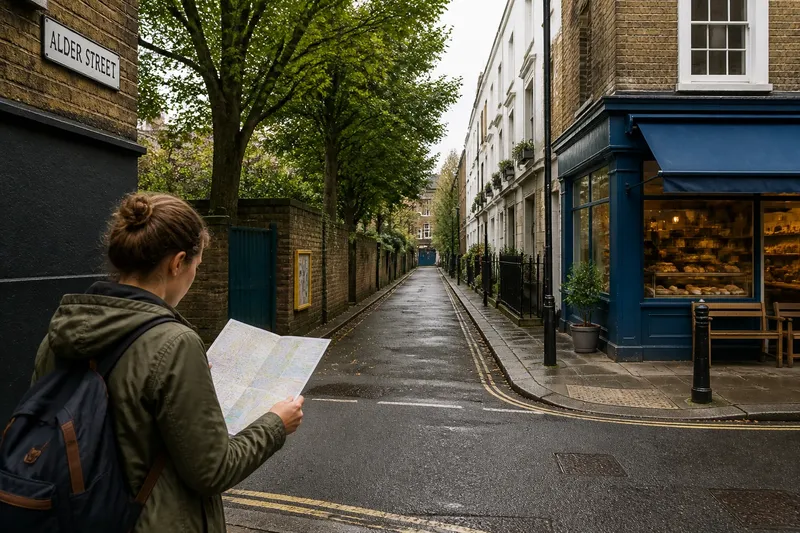
At Alder Street and the narrow lane beside a bakery, a visitor pauses with a paper map open. Street corner wayfinding starts with a simple question: which visible feature will help make the next turn clear?
A corner is a decision point, but it is also a useful way to break a route into manageable pieces. Instead of memorizing every storefront, connect a turn to a feature you can recognize from the direction you are walking.
What can you read from a street corner?
Look first at the view down each street. A long sightline might reveal a slope toward the waterfront or a row of trees leading to an avenue. A wall, bend, or parked vehicles may block the view. That limit matters: it tells you where you may need another cue.
The junction itself offers clues. Streets meeting at right angles create a different choice from a fork or skewed intersection. A broad corner may open up the view, while a tight one can hide the next street until you reach its edge.
Choose a feature that is easy to recognize at the moment you need to turn. It could be a mural, church tower, bus shelter, street tree, or distinctive shopfront. A modest cue right beside the junction can be more useful than a landmark visible from several blocks away.
How do turning points make directions clearer?
A turning point divides a walk into sections. “Walk toward the avenue, then turn where the brick wall ends” is easier to picture than a string of street names, especially when signs are hard to spot.
Notice what appears as you approach. An awning may come into view; a cross street may open toward a small park; a row of low houses may give way to taller buildings. These changes describe the route leading to a turn, not just the destination. If the expected cue does not appear, pause and check your location instead of continuing on guesswork.
Direction changes what you can see. A sign may face away from you, or a building may hide a familiar shopfront. Learn the cue from the side you will approach, and consider what the same corner looks like when you come back.
How can one unfamiliar walk become easier to follow?
Say you are meeting a friend at a community garden in an invented neighborhood called Bellwether. You know it is beyond a library, but several side streets have similar brick buildings. At the library corner, you see a narrow street framed by maples and a blue gate at the far end. The trees show the direction; the gate offers a feature to confirm as you approach.
You walk along the tree-lined street, keeping the library behind you. A broad cross street interrupts the trees. From there, you can see the garden fence beyond a low brick wall, though not the entrance. At the next junction, the wall ends beside a yellow noticeboard. You turn there, and the gate comes into view. The route now has a sequence: library, trees, wall, noticeboard, gate.
On the return, the blue gate is difficult to see from the opposite direction, but the noticeboard stands out beside the wall. You adjust the directions to “turn at the noticeboard, then look for the gate.” That cue links the turn to a feature visible from the approach, rather than relying on the destination alone.
What should you check at each corner?
Use these observations to decide which details belong in your directions or mental map:
- Approach view: If a distinct feature appears before the corner, use it to confirm your approach; if nothing stands out, rely on a nearby street sign or check your map before turning.
- Available turns: If one street continues straight and another branches away, name the branch in your directions; if the junction has several similar choices, pause to confirm the street names.
- Sightline: If you can see into the next street, use a visible landmark there as a guide; if a wall or bend blocks the view, choose a nearer cue at the corner.
- Stable cue: If a building detail, mural, or public fixture is easy to distinguish, tie it to the turn; if the cue seems temporary, choose a more lasting feature or a street sign.
- Return view: If the same cue is visible from the opposite direction, reuse it for the return; if it disappears from view, identify a separate cue for that approach.
- Street transition: If the pavement, building height, or street layout changes after the turn, use that shift to confirm you are on the right block; if it does not, wait for the next clearly identifiable corner.
It is not worth memorizing every doorway, parked car, or window display. Those details can change or blend together. Keep the route simple: choose cues that mark actual decisions and let the stretches between them remain ordinary blocks.
Which street corner cues work best for different situations?
Should I choose the biggest landmark?
Not necessarily. A small mural or corner shop can be easier to connect to a turn than a distant tower that appears from several streets. Choose a feature visible at the right moment and distinct from nearby alternatives.
What if a bend or building blocks the view?
Use nearer cues in sequence rather than expecting one long sightline. A change in pavement or the end of a wall can guide you to the next point where the street opens up.
How do I remember the route in both directions?
Check what you can see when approaching each important corner from the return direction. If the original cue is hidden, give that turn its own cue instead of reversing the forward directions word for word.
Can I use street corner wayfinding without a map?
Yes, if you connect each corner to the street you approached on, the next direction, and a recognizable nearby feature. In an unfamiliar area, a map or local directions can still help confirm the route.
How do street corners show where one route changes?
A corner can make a change in street layout easy to spot: a residential block may meet a busier avenue, or a narrow lane may open onto a broader street. For wayfinding, treat that change as a location cue rather than an invitation to assess how people use the public space.
For example, if a row of houses gives way to taller buildings just after a turn, that shift can help confirm you have reached the next block. Keep the cue specific: note what changes and where, then pair it with a street name or visible feature if the same pattern occurs elsewhere.
On your next unfamiliar walk, let a corner answer one practical question: what can I recognize here that tells me which way to go? Street corner wayfinding works best when the cue is visible from your approach and tied to a particular turn.